Why Some High-Hardness Knives Feel Glassy on Stones and Others Feel Sticky
People love to blame the stone. Too coarse, too soft, too cheap. But here's the thing: when you're sharpening a high-hardness knife and the feedback suddenly shifts from buttery to bizarre, the stone is just the messenger. That glassy feel or sticky feedback is your steel's metallurgy having a conversation with your hands. Hardness numbers above 60 HRC don't just mean "stays sharp longer." They mean you've entered a world where carbide volume, matrix structure, and burr behavior completely rewrite the rules of friction. One minute you're shaving steel like warm butter. The next, it feels like you're skating on ice or dragging through syrup. That's not user error. That's chemistry.
That Glassy Slide Is Actually a Red Flag
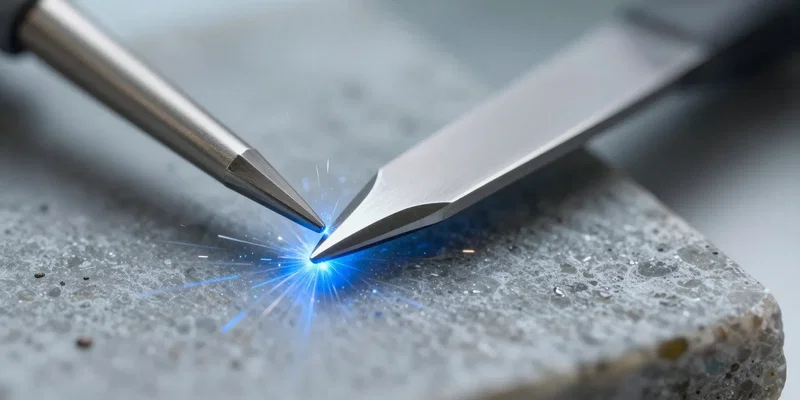
That slick, icy glide some high-hardness knives get on stones? That's the glassy feel. And it isn't necessarily your friend. What you're feeling is the abrasive biting into the steel matrix without grabbing. In steels packed with large vanadium or niobium carbides—think S90V, S110V, ZDP-189—the stone cuts cleanly around or through the hard particles. No drag. No chatter. Just an unnerving slide that makes you wonder if you're even removing metal. But actually, sometimes you are. The problem is the burr isn't forming a wire. It's fracturing off in tiny, invisible bits. Your edge might feel done. It might even shave paper. Give it ten minutes on a cutting board and the apex collapses because you were polishing a cliff, not refining a wedge. Glassy means pay attention.
Sticky Feedback Means You're Wrestling a Burr
Then there's the other guy. The sticky feedback. You push the blade forward and it feels like the stone wants to hold hands. Gummy. Resistant. Almost magnetic. This is classic burr behavior in a steel matrix that's tough enough to bend but hard enough to hold the deformation. High-hardness knives with certain powder metallurgy formulas—or even well-tempered ingot steels—can form a wire edge that laughs at your attempts to deburr it. The stone keeps pulling metal instead of cutting it. Your water turns gray instantly. The stone loads up. You chase the burr from one side to the other like a dog chasing its tail. Frustrating. But predictable. Sticky usually means the matrix is stronger than the abrasive's ability to sever the burr cleanly. You need a different strategy, not a different stone.
Carbide Chemistry Is the Puppet Master
Let's get nerdy for a second. The reason two knives at 62 HRC feel completely different on the same stone comes down to carbide chemistry and distribution. A steel like 1095 at 62 HRC is mostly iron and carbon. It sharpens simply because there's not much in the way. Now compare that to CPM-10V. Tons of vanadium carbides suspended in the matrix. Those carbides are harder than most sharpening stones. The abrasive has to either fracture the carbide, tear it out of the matrix, or grind around it. That changes everything. Steels with high carbide volume tend toward that glassy feel because the stone is essentially planing the surface between hard, unyielding particles. Steels with a tougher, more ductile matrix but moderate carbides lean sticky because the matrix deforms around the carbides instead of letting them pop out. It's not just hardness. It's what the hardness is made of.
Read the Feel and Fix Your Edge
If it's sticky, stop pushing so hard. Switch to edge-trailing strokes or strop on bare leather and let that wire burr dry out and snap off. If it's glassy, check your apex under a light. A slick slide can hide micro-fractures that'll crumble the second they hit a tomato. Don't just buy a more expensive stone and hope for the best. The glassy feel and sticky feedback are diagnostics, not defects. Your steel is literally telling you how its carbides and matrix want to be treated. Most sharpeners ignore the message. Don't be most sharpeners.