How to Rescue an Overpolished Edge That Slides on Tomato Skin
You spent three hours on that edge. Progressively finer stones. Leather strops. Maybe some fancy compound. Now the blade flashes like a sportscar fender. Beautiful. Absolutely useless on a tomato. You set the edge on the skin, push forward, and... nothing. It skates. The skin dimples. The tomato laughs at you. Here's the thing: a mirror polish looks incredible on camera, but tomato skin doesn't care about your Instagram likes. The surface is too smooth. Too slick. It loses the microscopic teeth that actually grip and slice into that waxy, slippery armor. You didn't dull it. You over-refined it. Big difference.
Dull or Just Too Polished? Spot the Difference
A lot of people panic and think they ruined the edge. Maybe. But probably not. Grab a sheet of newspaper. If the knife glides through like a laser, your apex is still technically sharp. That's the cruel joke. An overpolished edge can still shave hair. It can still slice paper. Then it hits a tomato and turns into a butter knife. Try the thumbnail test at an angle. A good edge with bite catches. An overpolished one just slips. Feel that? That's the problem. The knife is sharp, but it has zero aggression. No tooth. Like trying to file your nails with a marble countertop.
Add Teeth Back With a Micro-Bevel
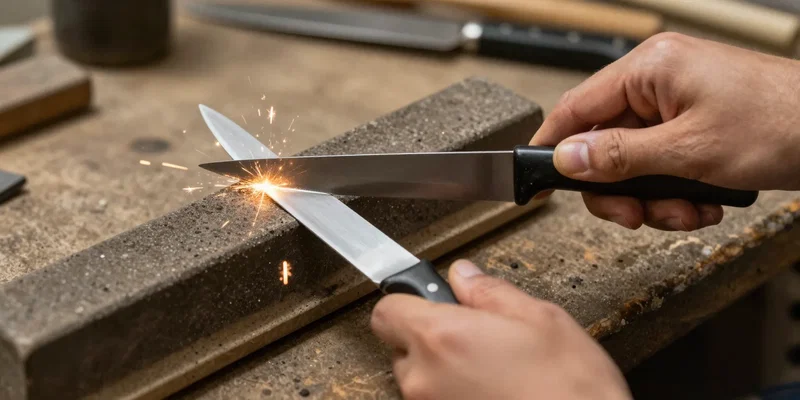
You don't need to start from scratch. That would be insane. Instead, raise a micro-bevel. A few quick strokes at a slightly higher angle on a medium or fine stone. Think five to ten degrees more than your main bevel. You're not reprofiling anything. You're just adding a tiny row of microscopic serrations at the very edge. A ceramic rod works too. Give it maybe five passes per side, light pressure. Check the feel. That's it. This sharpening fix puts the aggression back without trashing your geometry. Your edge is still thin behind the bevel. It still moves through food. But now it has bite.
Prove It on the Tomato
Time for the real exam. Grab a Roma, a beefsteak, whatever. Cherry tomatoes are the final boss because they roll. Place the blade against the skin and draw backward. Don't saw. Don't muscle it. A proper edge with bite catches immediately. You feel that slight tug, then the slice falls free with zero effort. If it still slides, your micro-bevel isn't aggressive enough. Go back. Two more strokes. Test again. You want that satisfying crunch as the skin breaks. Once it passes the tomato test, try a soft peach or a pepper. If it bites there too, you're golden. No more skating.
Stop Chasing Mirrors on a Kitchen Knife
Let's be honest. A mirror polish belongs on a straight razor or a showpiece. Not on your daily driver. Kitchen knives need tooth. They need to deal with skin, rind, and slippery nonsense. For long-term edge care, touch up that micro-bevel once a week if you cook daily. A quick few passes on a fine stone or ceramic hone. Forget the strops loaded with super-fine compound. They just polish away your bite again. Aim for a working satin or semi-matte finish on your bevel. It looks professional, it cuts better, and you spend less time fussing. Your tomato knife should bite, not blush.